Showing posts with label Tourism. Show all posts

Saturday, April 7, 2012

VISITA IGLESIA: A TRADITION AND A WAY TO PRESERVE AND TO CHERISH

Visita Iglesia is one of the most beautiful traditions in the Roman Catholic Church.  This Lenten pilgrimage is a demonstration of our faith and belief that life is a journey, it is a pilgrimage and as pilgrim our main objective is to reach the goal of our journey.  I would like to share with you some photographs that I have of the different churches in Bicol particularly in the province of Albay where I live. Perhaps in the future or next year if you do plan to visit Bicol try visiting these churches.  Like many places in the Philippines there are beautiful baroque churches here in Bicol made of volcanic rocks or made of brick.  I am sure that the authorities have done a great job of preserving this architectural treasures.  These artifacts are not only places of worship but they speak of our history and soul as Bicolanos and of our great Christian heritage. What saddens me though are the various renovations of the interior that destroyed the originality and the history of these churches.  Some parish priests perhaps do it for purposes of liturgical renewal as they say it what the Vatican II says or PCP II.  But I don't think Vatican II documents authorized the removal of communion rails, choir lofts and pulpits.  I wish that these parish priests could be invited in old places like Europe where even modernity never dared to alter the interiors of great cathedrals.  I hope that our religious authorities will have the sensitivity and appreciation for art and humanities.  Now to explain this beautiful tradition of visita Iglesia may I suggest this blog I have found on the net.  The title of the blog article is  Visita Iglesia, History, Tradition and Significance. 

The Parish of St. Stephen Protomartyr, Ligao, Albay, P.I.

The Cathedral of the Diocese of Libmanan, the Patron Saint is St. James the Apostle

Cathedral of the Archdiocese of Caceres in Naga City, Camarines Sur, P.I.
The patron Saint is St. John the Evangelist

Parish Church of St. Anthony of Padua, Gubat, Sorsogon

Parish Church of St. John the Baptist, Tabaco City, Albay P.I.

Cathedral of the Diocese of Sorsogon, Sorsogon P.I. The Patron Saints are
Peter and Paul

The Parish Church of St. Dominic of Guzman, Sto. Domingo, Albay, P.I.

Parish Church of St. Rose of Lima, Bacacay, Albay, P.I.

Parish of St. Michael the Archangel, Caramoan, Camarines Sur

OBSESSION OR FASCINATION, WHICH EVER...

I don't know why I am always compelled to take snap shots of Mt. Mayon Volcano every time I have the opportunity to do so.  I do not know how to call this compulsion.  Is this obsession or is this fascination? The Webster Concise Dictionary of the Modern English defines obsession as fixed idea or the domination of the mind by one idea.  Well, at this point in time I won't call this obsession I would rather call this experience as fascination.  When one is fascinated by one thing, it draws interest and curiosity and to the highest level love and appreciation.  I would opine that I am not the only one who has this kind of fascination for Mt. Mayon.  Perhaps there are various people with varied interests about this volcano.  From photography, to mountain climbing.  Albay Province is mountainous although not really tall mountains.  But the perfect cone shape of this volcano is what fascinates almost everyone.  It has become a natural landmark and symbol of our identity as Bicolanos.  We find the image of the volcano in our paintings, drawings and even on official seals of government units, offices and schools.  If there is any natural landmark that best symbolize our identity it is Mt. Mayon.

Mt. Mayon has a long history.  It is actually beautiful that is why it is called Mayon.  The name comes from the native term   "Daragang Magayon", which in English is translated as fair maiden or beautiful maiden.  On moderate weather conditions precipitation causes clouds to cover the tip or some parts of the volcano giving it the maiden-like appearance of bashfulness.  By the way in Bicolano culture, ladies or maidens are expected to be bashful especially in the presence of males and strangers.  Thus earning the moniker, "Daragang Magayon".  But Mt. Mayon has its temper too.  It can be unpredictable during eruptions.  It can be violent during volcanic eruptions, but it is also has made the surrounding areas fertile. Thus despite of the dangers, villagers still prefer to live along its side because of the fertility if offers that is best for raising crops and for planting.  But now with the climate change in progress, things will change.  Like us, Mt. Mayon will be also learn how to cope with the changes.  But whatever happens, Mt. Mayon will still retain its iconic image as a symbol of our identity, as symbol of our souls.  Beautiful, strong, temperamental, but resilient always looking forward and adapting to new challenges.


Mt. Mayon as seen on an early morning cruise at Sula Channel in Santo Domingo, Albay

Mr. Mayon as seen from Tabaco Bay

Mt. Mayon as seen from Bacacay, Albay

Mayon as seen from the Ocean

Mt. Mayon and the eastern sea board

Mt. Mayon as seen on the wings of love.

It's like being on Shangrila 

So Near and Yet so Far

Saturday, July 2, 2011

Unforgettable Aceh: Nuggets from my Short Visit to Banda Aceh


This Ship was pushed inland by the great tsunami that struck
Aceh several years ago, nos a Museum Piece

My memories bring a year's back to my visit to Banda Aceh in Indonesia.  I really appreciate the opportunities given me by East-West Center in Hawaii to participate in their Summer Institute on International Humanitarian Law in Bali, Indonesia.  This field trip to Aceh was part of this program.  So when they offered this as an addendum to the activity I immediately applied.  I was pretty sure that I dont want to miss this occasion of visiting a wonderful place of which several years ago occupied the headlines because of the tsunami and the subsequent peace agreement beteween the rebels and the Government of Indonesia.  I've read so much about Indonesia and I appreciate its diversity.  from end to end you see a country so vast with different cultures and subcultures.  No wonder the founding father of Indonesia adopted the philosophy of Pankasila - Unity in Diversity.  For no one can really unite this archipelago except for a philosophy of unity that would bind its people.   Aceh has has seen some separatists movements and the later part was more bloody.  But fortunately after the tsunami the rebels and the government went into the negotiating table to talk about autonomy and self-rule. 


The Party Offices of the Ruling Party in Aceh
The photo above is the party offices of Parti Aceh.  We did some focus group discussions with its leaders during our visit.  The itinerary of our visit was so hectic and we only had three days of field trip.  We were so tired but I did my best to keep awake as I did not want every moment of my stay in Aceh escape my attention.

The Capitol Building of Aceh
We did visit also the government house in Aceh.  We had a dialogue with the vice-governor who himself was a former rebel.  After the Peace talks he was elected into various offices.

The Grand Mosque in Aceh.  The Acehenese People are staunchly devout Muslims.  This huge and impressive structure provides inspiration and becomes a source of pride for the people of Aceh.
The people of Aceh are devout Muslims.  I had wanted so much to enter the mosque during Friday prayers but I was not able to get inside since the guard won't let me in because I am not a Muslim.  We stayed outside for a while and listen to the sermon.  After the services were over, we were then allowed to get inside.  I was very curious because I have never been inside a Mosque, having lived in a predominantly Christian environment, I never had the opportunity to be inside a mosque.  But I admire how the men and women of Aceh love and respect their religion.  


The Streets of Banda Aceh are wide and clean.  It is a small city and  in less than a day anyone can go around the city.  Motorcycles are popular means of transport.
There is also a dress code in Aceh.  Islamic way of dressing is enforced by some form of local ordinances.  I think I have no problem with this.  In fact how I wish there would  also be a dress code in our country.  I


Motorcycle is a common means of transport for both men and women

Some Morrocan Inspired Architechture 
How I wish I could visit again this beautiful city.

Friday, April 22, 2011

San Juan Bautista Church of Tabaco City: Simbahan ko Padangat ko!

Most of my years were spent in this town.  I am a traveler by nature, and I love to  visit places.  But in the end I always come home to this beautiful town.  In the vernacular we have saying which goes this way - no matter how long the procession is, it always end up in church.  This means that wherever I go, no matter how far, I will always come home to this town.

Today is Good Friday and after visiting the church for the Sacrament of Penance I decided to take pictures of the San Juan Bautista Church in Tabaco City.  This church was named by the National Commission on the Culture and the Arts (NCAA) as a national treasure.  The structure contains various peculiar markings of masons.  The church is made up of lime and volcanic stone.  This church has been the subject of various blog on the internet.  I used my HTC Wildfire mobile phone camera to take these snapshots. 


The Cherubim, angels standing before the throne of God ready to serve.


Church authorities have done the right thing to cordon this outdoor altar.  Unscrupulous lovers often use these area as dating place and ignorantly would sit on top of the altar!!! With these rails vandals and daters were prevented from desecrating this holy shrine.

The Main altar covered with purple curtain is all set for the Good Friday Liturgy.

The altar of repose, where the Eucharistic Christ is adored by the faithful.

The patio
Truly a jewel, a work of art and a master piece!

Wednesday, April 20, 2011

Kawa-kawa Hill: Fun, Adventure and Religiousity Remix

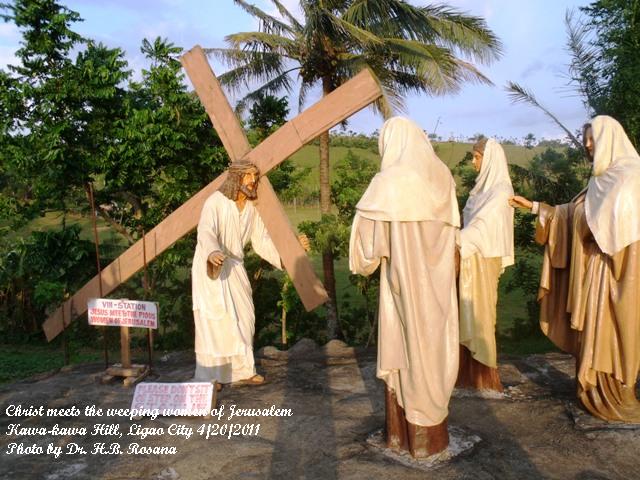
Albay Province in the Philippines boasts not only of its beautiful beaches, mountains and resorts but in an interesting way, fun and adventure mix together with the natural religiosity of the people. The Kawa-Kawa Hill in Tuburan, Ligao City is a classic example.  The name Kawakawa is the native word for wok because the hill top is crater like a sort of a mini-plateau that resembles a wok.  The crater is surrounded by hilly elevation.  Surrounding these hills are more-than life-size dioramas of the stations of the cross.  One has to climb the 236 meter high hill to reach the top.   As you go around the hill-top you get to relive the passion of Christ as you visit all those dioramas.  Those who intend to visit this shrine or hill, Ligao is just an hour's drive from Legazpi City.  There are buses, vans and taxis that serves commuters.   To those who conceptualize this, congratulations for coming up with a very interesting and meaningful tourism spot in Ligao.  May your tribe increase!!!

Votive Candles at the first station.  You can bring your own candle or buy from the religious store near by.


The Last Supper

"Can you not stay awake with me for an hour?"  The disciples overtaken by sleep as Christ prayed in Gethsemani


The Agony in the Garden

Christ stands trial before Pontius Pilate with the Jewish High Pries Annanias accusing Him.

Christ was mocked and reviled by the soldiers and crowned Him with thorns and hailed Him as King of the Jews

Christ is made to carry His cross to Mt. Golgotha

Under the wight of the Cross Christ falls for the first time

Simon a Cyrenean is made to carry the Cross of Christ

"Cry not for me, but cry for yourselves and for your children..."  Jesus meets the women of Jerusalem

Christ is crucified.  The whole sky was covered with darkenss as the Son of God offered Himself to God the Father.

Son Behold your mother, woman behold your son, Mary becomes the Mother of the Church at the foot of the Cross

At evening, Christ died on the Cross

Joseph of Arimatea boldly claimed for the Body of the Lord

Since I live you too shall live.  Christ is Risen Alleluia!

Tuesday, April 19, 2011

From Cagsawa to Daraga

It's Holy Week again and in the liturgical calendar of the Church we celebrate in a whole  year the life and mystery of Jesus Christ.  One of the fondest devotions among Filipinos is the Visita Iglesia where one is promised a plenary indulgence if one would visit seven churches on holy week and pray for the intention of the Pope.  One who intends to do this must be in a state of grace in order to receive the plenary indulgence.  

To those who are fond doing visita iglesia, and if you are somewhere near, don't miss to see the Church of Daraga in Albay.  Built by the Franciscan Missionaries in the 16th Century and today stands as a living witness to the faith of a people despite disaster are able to survive.

Daraga Church atop on a Hill overlooking the entire City. 
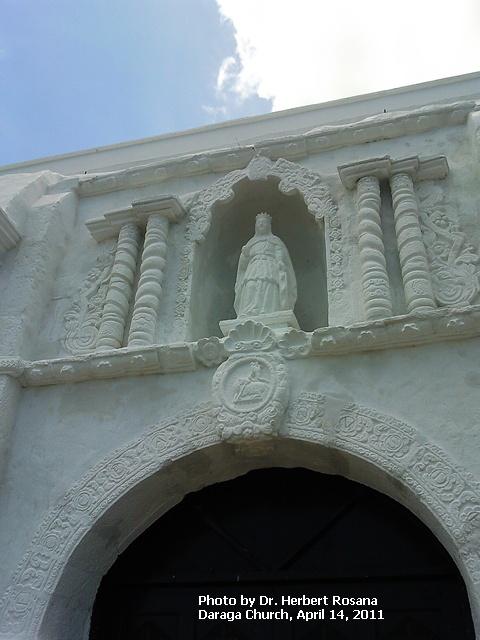
The Church is set up on a hill overlooking the city of Legazpi and the entire environs of Daraga, Albay. The municipality of Daraga borders the hilly portions of the Albay and Sorsogon provinces while on the east are the valleys and coasts facing the Albay Gulf and Pacific ocean.  Strategically the church was built on top of a hill as a precaution against volcanic eruption and mud flows.  The sad experience of the old church of Cagsawa on the plain has taught the succeeding builders to relocate the church on top of the hill.  The location is also symbolic in a way because it portrays the missionary role of the church to evangelize the native people and to show everyone the light of Christ.  On top of a hill she (the church) proclaims the message of salvation.  Inviting everyone to embrace her faith in the Son of God.
The facade of the Daraga Church

The face of the church, recently painted with white. Here is a link that will help you understand the history of this parish church. Parish Church of Nuestra Senora de la Porteria.
Majestically nestled on top of a hill with Mt. Mayon Volcano on the Background

The Convent, colonial style of architecture

Historical Marker

The Image of our Lady of the Gate