Monday, December 31, 2012

SIEM REAP TRAVEL LOG

Let me share with you my recent travel diary...
Cambodia used to be a French colony.  There are many French style architecture in the City.
For the past few days I have been wanting so much to write on this blog but it seems that time and opportunity was wanting due to the many obligations I have to fulfill.  This holiday trip has long been in the making. Whenever I tell friends about this I always get the answer, "Why Cambodia?"  My fascination for this country came as far as I was in high school way back in the 80s.  I was a  a voracious reader and until now still is.  One of the magazines I love most was the National Geographic magazine.  Its glossy pages and vivid pictures as well as its  interesting stories bring me to a plethora of imaginations.   One of the materials on the magazine that really fascinated me was the Angkor Watt.  I have read many things about Hinduism and Buddhism.   My interest in these fields grew partly  because of my exposure to oriental philosophy while attending university (I am a Philosophy major).  During my high school and college years, I also developed the hobby of listening to shortwave radio. In the 80s and 90s cellphones and satellite TV was not yet in.  One of my hobbies then was to pick up broadcasts coming from different countries using my short wave radio receiver.  I also got to hear clandestine radio broadcasts coming from the Khmer Rough and later on from the resistance groups.  

Nice lodging at the MEKONG Bed & Breakfast at Taphul Road, Siem Reap, Cambodia.  Clean, air conditioned, with hot and cold water and other amenities for 15 USD a night. 


It can be dusty during the dry season


Last June 28 to July 2, 2012, I was able to squeeze a short segment of my time to visit Siem Reap.  Taking the opportunity that recently the Cebu Pacific Air opened a direct flight schedule  from Manila to Siem Reap, Cambodia.  With my camera and notebook off I went to Siem Reap. I arrived in Siem Reap around past 9:00 p.m. in the evening.  I stayed at the Mekong Bed and Breakfast Hotel.  It was a nice hotel.  The staff were courteous, the room was nice and clean and imagine for only $15 dollars a night.  That was really value for money.  I opined that in other places I've went to, that kind of hotel accommodation would have cost me from 25-35 US dollars.  But here it seems a little bit cheap because of the stiff competition among hotel owners.  But I think they would not run out of customers because of the hordes of tourists visiting Siem Reap daily and much more on peak season.  When I arrived I immediately headed for my bed because next morning I have to be very early to catch the sunrise at Angkor-watt. 

The Busy shops in the morning is automatically converted into a pub street at night time.  The Pub street is frequented by tourists and locals at night.  One can spend a leisurely night in the various pubs located on this street.  Massage is also freely offered on the street.


The Second Day (Friday) 

Sunrise at the Angkor Watt is something never to be missed.  So at exactly 4:00 a.m. I woke up and met the tuk-tuk driver who will take me to the Angkor Watt.  There is such serenity and beauty in this ancient structures as it appears on a silhouette.  Surprise that even on an early morning there are already hundreds of tourists on the ground.  I bought a ticket for $40 which is good for three days.  One day visit to the Angkor Archaeological Park is not enough as it is huge and vast and there are so many ruins and temples to visit.  As a useful tip, one would appreciate the beauty and significance of these archaeological pieces if one has read or has a background into the history of the Khmer Empire. Otherwise you will simply get tired of looking into heaps and piles of stones.  So if you are a tourist that is interested in culture and the arts, Siem Reap is for you. 

I bought a ticket that would allow me to visit the Area for three days.  The ticket  was worth 40 USD
My Tuk-tuk driver.  We left the hotel very early to catch up with the Sunrise at Angkor Watt

The Entrance to the Main Gate of the Angkor Watt


The Angkor Watt undergoing some minor restoration work. It was a bit of a disappointment for me as I was wishing to take a good photo of the monument when these drapes where placed. 


Another View of Angkor Watt at Sunrise.  The best way to view the Angkor Watt is during the sunrise and sunset.  I did my best to be here by sunrise around 5:00 a.m. to be able to see the sun rise and see how dramatic the view unfold with the Temple appearing in a silhouette.


The author at the lower courtyard of the Angkor Watt.  Kindness comes in unexpected places.  I was trying to set the automatic timer of my camera when all of a sudden a Caucasian tourist volunteered to take my photo.  He was kind enough to help me get a photo of myself.  I did not bring along a tripod so I practically have to set the camera in stage where it can perform its automatic function.  This was not the first time however I encounter this kindness.  In the Bayon temple I also encountered a French-Canadian tourist who volunteered to take my picture.


Inner Courtyard of Angkor Watt.  I think the Angkor Watt has three or four layers.  They said that the main stupa is as high as the Notre Dame Cathedral in Paris.


By around 8 a.m. the hordes of tourists began arriving by droves in bus loads. This is not the peak season by you could see the number of tourists coming.  The Angkor Watt is the most visited site among the many temple complexes in the Angkor Archeological site.  If you want to enjoy your visit and avoid being distracted by the huge crowd come very early...as early as 4:00 a.m.  You will have the chance to watch the sunrise and at the same time be able to explore the interior, the inner court yards before the arrival of the crowds.


Some of these crowds are organized by tour agencies, some coming from neighboring Vietnam.  Some of the Cambodians I have talked to always mistook me for a Thai or Vietnamese.  Notice the color coding of the caps and the flags.  These are the means by which tour agencies organized their groups.  An efficient way to organize large tour groups.


I spent my early morning at the Angkor Watt.  There were a number of tourists roaming around and it is so hard to find yourself alone.  But if you want to avoid the hordes of tourists that visits the Angkor on a daily basis come to this area as early as you can in the morning.  That will give you some little space to meditate and to savor the experience and to study in detail the various artifacts. Unfortunately just near the entrance you will be met by overzealous vendors.  One vendor was trying to coax me into buying his book at 25 US Dollars.  I paid him no attention.  But he kept on pursuing me and lowered the price to 18 US Dollars.  Surprisingly when I was about to leave he dropped the price to 1 US Dollar.  If you are in Cambodia you have to master the art of bargaining.  Bargaining far from a nuisance is an art.  It is also enjoyable and you can practice the art of negotiation in order to maximize your interests.  You will be perceived as gullible if for the first offer you easily accede to the price.  


Pre-Rup, one of the imposing characteristic of this ruins is its stately appearance.

The Top of Pre-Rup gives one a commanding view of the surrounding environs.  This temple like other Hindu Temples is located at the center of the City. Many centuries ago there was once a city around this temples.  Temples are always built at the center.  This temple is associated with funerary.  They said this is where cremations are done.  This was once a state temple.


After the viewing at Pre-Rup the driver of my rented "Tuk-tuk" asked permission if he could go to a wedding party, but eventually ended up inviting me to go along with him.  I've never been to a Cambodian wedding party and I was a bit curious.  Though my driver could not speak English well and we have some difficulty communicating, I understood from him that whenever someone is invited to a wedding party, the guest have to pay something.  He informed me that I have to pay 10 US Dollar to the minimum.  I was also curious and I considered it one of a life time experience so I gave in to him.  I thought that this is fair enough because it was lunch time and if ever I decide to eat in one of the open door restaurants I would be spending the same amount of money.

A Taste of Cambodian Wedding Feast.  The liquor was overflowing I could not imagine drinking almost four cans of Angkor Beer.  I enjoyed the food.  Though I find some herbs unusual for my taste.  But in general the food was very good.  I enjoyed using chops sticks.


All the guests were dressed in their best.  I was a total stranger.  I was wearing my shorts and had a backpack.  I felt I was out of place and I had difficulty communicating with those seated with me on the table.  But I noticed that the younger generations are able to speak conversational English.  Some are apologetic and asked me to be more patient with how things are going in Cambodia.  But generally I find the people hospitable.


Wedding Parties have tents like these.

 We visited another smaller temple called Ta Som.


Ta Som

 A whole day is not enough.  After this visit I called it a day and I went back to the hotel to take my rest.  I was forced to go back to the hotel because of heavy torrential rains and thunderstorms. 

Third Day (Saturday)

On the third day I decided to go back again to Angkor Watt.

I visited Bantay Srey.  This is one of the most well preserved of all the temples in the area. Let me share with you some of the photos I have taken.


These were the victims of Land Mine with their musical performance. The countryside were littered with land mine during the war period.  Innocent civilians were often the victims of these land mine.

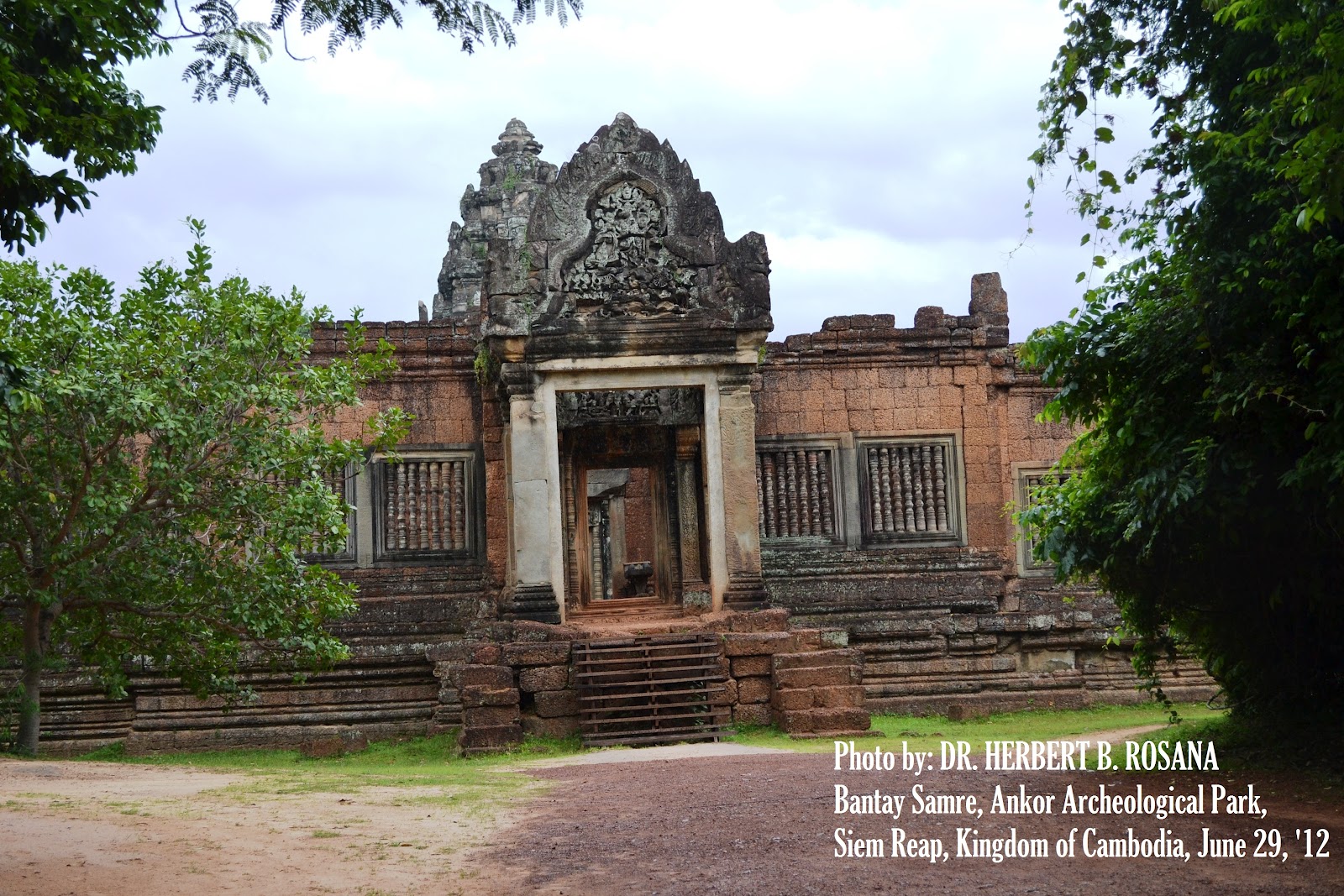
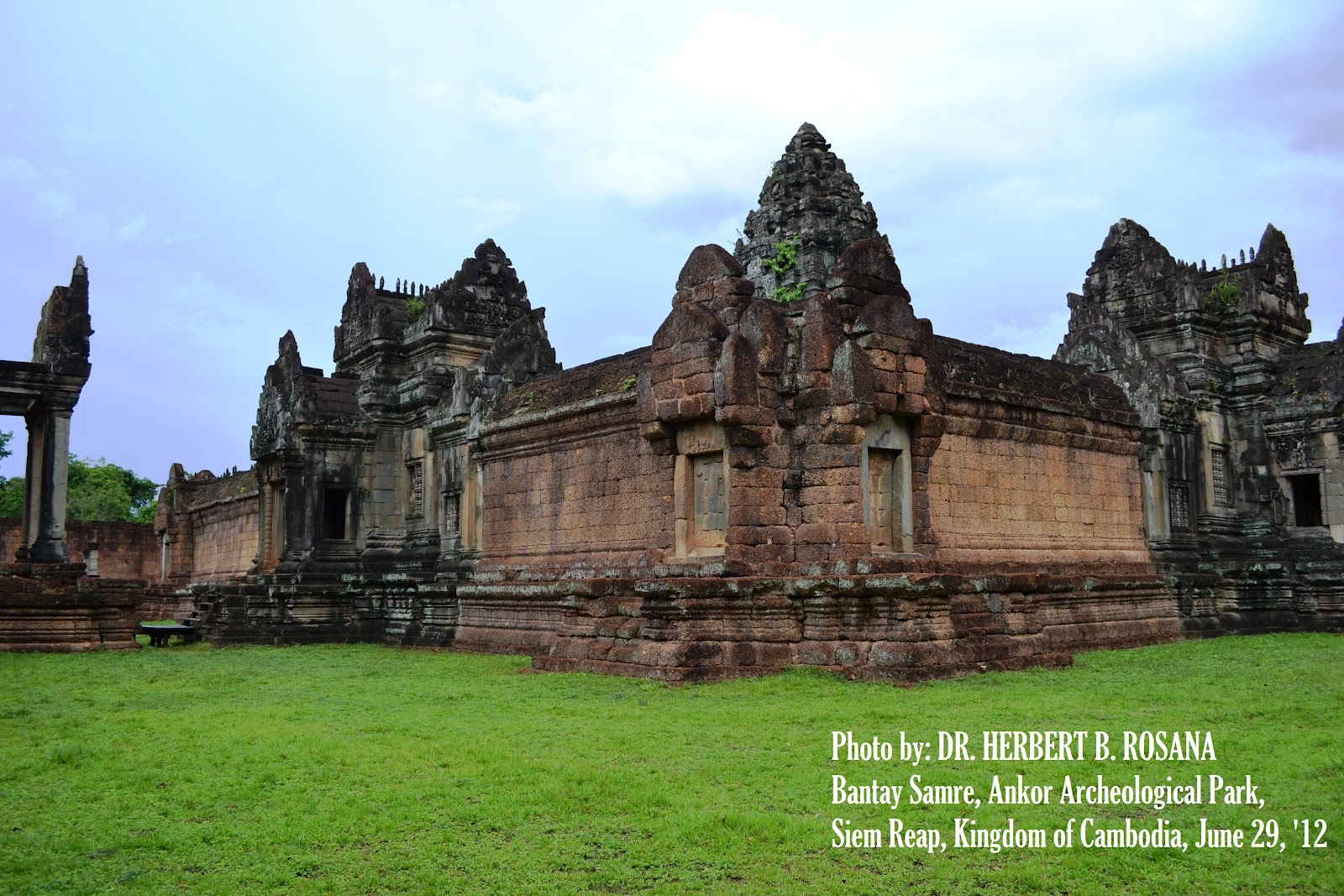
I took my lunch in one of the cafes in Bantay Srey.  And after this I immediately proceeded to Bantay Samre.  Another Temple located several miles from here.  In contrast to Angkor Watt this temple area is less visited.  When I went to this temple around 2:00 p.m. there were only a couple of tourists around.  I could also hear the chuckles and jesting of the maintenance workers.  I enjoyed the time there.  The quiet and the peace.  I also enjoyed the time spent to look closely on the structures without being disturbed by too much human traffic. It was also from here that I bought a little brass figurine of an apsara with a bell at its base bottom.  Here are some of the photos:


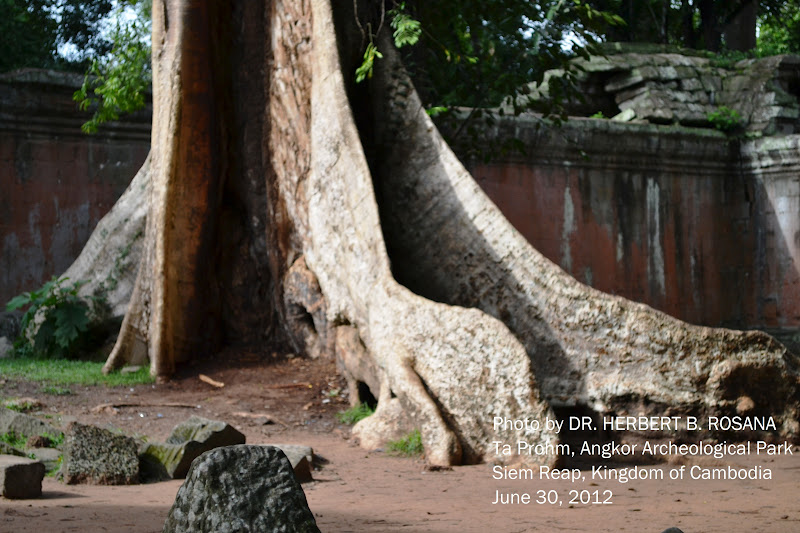
After an hour and a half visit to Bantay Samre, I decided that its time to move to the next destination - Ta Phom, as the afternoon sky begin to brew with thunderstorm.  I am happy to have with me my umbrella and my backpack has a plastic cover.  So we headed for Ta Phom.  My Tuk-tuk driver instructed to return to exit in the same direction as where I came from, that is, on the eastern side.  I never paid attention to his instruction and on my exit I found myself going out of the west gate and that was almost a couple of kilometer from the east gate.  So on my way out I have to go back and run the couple of kilometers back.  It was here that the strong torrential rains caught up with me and I have to take shelter among the ruins.  As I took shelter among the ruins I was scared because the policemen officer I met told me to hurry up as the museum was about to close.  I decided to brave the torrential rains.  Along the way I was met by my Tuk-tuk driver who decided to walk and try to look for me as he was worried what took me so long. The people who rehabilitated this temple decided to leave some vegetation over the ruins.  Perhaps to give the idea how these temples were originally discovered by historians and archaeologists.  It was noted however that the heavy traffic of tourists have created some stress to the giant trees and vegetation.  The tropical climate and the humidity of the place contributed to the growth of vegetation.  But Here are some photos of Ta Phom:


After my visit at Ta Phrom, I decided to go back to the hotel for the much needed rest.


Monday, April 30, 2012

OF ANXIETY AND APPREHENSIONS

Legazpi Port
Next Week my students will be doing their field research project in Victory Village in Legazpi City.  I've seen their apprehension and anxiety as they plan to go about their project.  But this this pretty normal in almost all situations.  This part of apprehensions and anxiety is also a learning experience for everyone.  As they go thourhg with it, they will get realizations and insights.

THE PECULIARITY OF JUSTICE AND EQUITY

Barangay Victory Village-North, Legazpi City, Albay, the Philippines
Building a City and making it livable is a challenge.  The saying "all is fair in love" may not apply in development work.  For indeed in some respect societies develop but social justice and equity remains ideals to be realized. In some places poverty and lack of opportunity for employment are the causes of poverty and decline while other areas improves and develops.  As they say there are two sides to a coin.  On one hand the government does all it can to help and integrate people to the economic life.  On the other hand it also takes a concerted effort on the part of the marginalized people to take action and decide for themselves.  Often ignorance and lack of education contributes to inaction and complacency.  My students will be doing a field research project in Victory Village North.  This village used to be situated near the coastline and today it is still.  But with the addition of the building of a tourist and commercial areas that has symbolized innovation and progress.  How does the people view the tourism development plans of Legazpi City in this village.  Have they benefited or putting the question in another form, did this tourism development projects provided them with opportunities?  I hope that this activity will not only teach my students the methods and processes of research but also awaken in them a social conscience that will make them more conscientious and active citizens who will advocate progress but at the same time care for people.

Tuesday, April 10, 2012

PEACE AS A DISCIPLINE


The truth shines like the sun but it eludes the pretentious and the arrogant.


Peace has become a discipline in it's own right. As a discipline it has three areas of interests, (1) Peace Research, (2) Peace Education and (3) Peace Advocacy.  Those who profess peace should be well grounded in the principles, theories and assumptions of the discipline.   Thus, like a ship captain and like the rudder of a ship, those who profess the discipline must truly be grounded on the said foundations because they are suppose to lead the development of the discipline.  They should be able to speak it's language, know how to manipulate it's tools and know how to apply its practicality.  The goundedness of those who profess peace as a discipline can be gauged by: (1) their track record in the practice of the discipline, (2) their scholarly work, and (3) a genuine desire to further advance the discipline and for no other motive for self-gain or for political reasons.  Like a bird seeking shelter Peace can be elusive.  It eludes the insincere and the opportunists.  It does not use arrogant or despicable language and seeks to achieve virtues.  Only a true shepherd can love the sheep. The hireling Shepherd will only seek the wages and not the welfare of the fold.  Only a mother can truly love her child, a care-giver will only seek wages.  So those who truly profess the discipline are the ones that can truly care for it.   

Sunday, April 8, 2012

ARE WE READY TO LIVE IN ORDER TO DIE?

The Image of a Buddha in Meditation


I was reading the book, "Advice on Dying and Living a Better Life" written by H.H. Dalai Lama of Tibet as translated into English by Dr. Jeffrey Hopkins.  From a personal perspective as well as tool for teaching philosophy, I found the book interesting and valuable.  Actually I found this book in a book sale about a year ago.  This is the third time that I am re-reading the book.  The Easter holidays has provided me a respite from my work which enabled me to devote some little time for serious reading.  In this blog entry please allow me to share with you some little nuggets of reflections I had while reading the book.  This is not a comprehensive review and neither do I consider this a review but simply a sharing of my impressions and reflections.  In the book, the Dalai Lama presents intelligibly the major themes or concepts within Buddhist philosophy such as the theory of Impermanence, Karma, and dependent origination.

Our bodies are products of karma produced in a series of life cycles.  Karma means the law of cause and effect.  Karma is different from what is colloquially known in this country.  Here in the Philippines it is pretty normal for anyone to say that one will suffer the fate of karma if one does evil.  Or simply put it we have come to use the term for retribution.  But in Buddhist philosophy from where we got the word Karma, the term has a different dimension in meaning.  Karma is the law of cause and effect.  This means that whether our actions are good or bad it has a corresponding consequence. That present events, situations, mental dispositions and attitudes are product of past action spanning not only our life time but even the past lives we have had.   In fact the cyclic existence of birth, death and rebirth have their origin in Karma.  The affirmation of individuality or the affirmation of the seeming reality of the self is the product of ignorance.  This ignorance fuels karma and is the cause why we are trapped in the cyclic existence in the Samsara.  The basic characteristic of this cyclic existence is suffering.  Suffering stems from our ignorance.  The affirmation that individual phenomena are real is the product of ignorance.  To consider phenomena as permanent is ignorance.  It is like holding on to water with your bare hands only to see them slip away in seconds.  Only the practice of meditation, tantric yoga can help overcome ignorance. 

        Thus confronted by the sea of impermanence the Dalai Lama invites everyone to take refuge in the three jewels, The Buddha, the Dharma (teachings) and the Sangha (the community).  It is the conscious effort that will help us achieve enlightenment through the help of these three jewels.

        The idea of reincarnation has been sensationalized.  Stories were written about it and on the extreme bizarre ideas have been associated with it, such as believing that you were some sort of person in past lives, or that you were a priest in Egypt in ancient times.  I opine that stories like these are borne of ignorance and are meant to entertain of which only the gullible will believe. But to recall our past lives or even if that would be possible which is not the case, is not important anymore.  For the practical reason that it will not help improve our lot in the future and that there is no real self.  The individual “self” that we consider is the product of illusion and ignorance, because there is no self at all.  Thus one manifestation of ignorance is the cherishing of one’s self.

        The body is different from the mind.  This thought is central to the reason why we need to work our own enlightenment so that we could achieve a better reincarnation in the future. Unlike Western thought were the direction is linear, eastern philosophy is cyclic.  Time is immaterial; there is no running out of time.  Thus, achieving nirvana (nothingness) or the Buddhist concept that is roughly equivalent of our concept of heaven or salvation is something that needs to be worked out continuously and even on several lifetimes.  The practice of yoga is hinged on the idea that death being the disintegration of the body elements must be taken cared of because one's state of death or practice of yoga will specify what kind of reincarnation we will have.  That is why the Dalai Lama advised the practitioners to workout and wished for a reincarnation where one will possess intelligence or consciousness that will allow us to continue the practice of yoga so as to achieve progressively until we achieve nirvana.


I would opine that the Dalai Lama has a more complicated teaching about this but this is beyond my reach now.  These are just the nuggets of reflection I got from the Book.  The book was interesting though.  The reason why I love to study Buddhist philosophy is because its rationality blends with spirituality.
This is the kind of thing absent from the empty, empirical sciences of the west.  After all science is not the only source of knowledge.  it does not have the monopoly.


Saturday, April 7, 2012

VISITA IGLESIA: A TRADITION AND A WAY TO PRESERVE AND TO CHERISH

Visita Iglesia is one of the most beautiful traditions in the Roman Catholic Church.  This Lenten pilgrimage is a demonstration of our faith and belief that life is a journey, it is a pilgrimage and as pilgrim our main objective is to reach the goal of our journey.  I would like to share with you some photographs that I have of the different churches in Bicol particularly in the province of Albay where I live. Perhaps in the future or next year if you do plan to visit Bicol try visiting these churches.  Like many places in the Philippines there are beautiful baroque churches here in Bicol made of volcanic rocks or made of brick.  I am sure that the authorities have done a great job of preserving this architectural treasures.  These artifacts are not only places of worship but they speak of our history and soul as Bicolanos and of our great Christian heritage. What saddens me though are the various renovations of the interior that destroyed the originality and the history of these churches.  Some parish priests perhaps do it for purposes of liturgical renewal as they say it what the Vatican II says or PCP II.  But I don't think Vatican II documents authorized the removal of communion rails, choir lofts and pulpits.  I wish that these parish priests could be invited in old places like Europe where even modernity never dared to alter the interiors of great cathedrals.  I hope that our religious authorities will have the sensitivity and appreciation for art and humanities.  Now to explain this beautiful tradition of visita Iglesia may I suggest this blog I have found on the net.  The title of the blog article is  Visita Iglesia, History, Tradition and Significance. 

The Parish of St. Stephen Protomartyr, Ligao, Albay, P.I.

The Cathedral of the Diocese of Libmanan, the Patron Saint is St. James the Apostle

Cathedral of the Archdiocese of Caceres in Naga City, Camarines Sur, P.I.
The patron Saint is St. John the Evangelist

Parish Church of St. Anthony of Padua, Gubat, Sorsogon

Parish Church of St. John the Baptist, Tabaco City, Albay P.I.

Cathedral of the Diocese of Sorsogon, Sorsogon P.I. The Patron Saints are
Peter and Paul

The Parish Church of St. Dominic of Guzman, Sto. Domingo, Albay, P.I.

Parish Church of St. Rose of Lima, Bacacay, Albay, P.I.

Parish of St. Michael the Archangel, Caramoan, Camarines Sur

OBSESSION OR FASCINATION, WHICH EVER...

I don't know why I am always compelled to take snap shots of Mt. Mayon Volcano every time I have the opportunity to do so.  I do not know how to call this compulsion.  Is this obsession or is this fascination? The Webster Concise Dictionary of the Modern English defines obsession as fixed idea or the domination of the mind by one idea.  Well, at this point in time I won't call this obsession I would rather call this experience as fascination.  When one is fascinated by one thing, it draws interest and curiosity and to the highest level love and appreciation.  I would opine that I am not the only one who has this kind of fascination for Mt. Mayon.  Perhaps there are various people with varied interests about this volcano.  From photography, to mountain climbing.  Albay Province is mountainous although not really tall mountains.  But the perfect cone shape of this volcano is what fascinates almost everyone.  It has become a natural landmark and symbol of our identity as Bicolanos.  We find the image of the volcano in our paintings, drawings and even on official seals of government units, offices and schools.  If there is any natural landmark that best symbolize our identity it is Mt. Mayon.

Mt. Mayon has a long history.  It is actually beautiful that is why it is called Mayon.  The name comes from the native term   "Daragang Magayon", which in English is translated as fair maiden or beautiful maiden.  On moderate weather conditions precipitation causes clouds to cover the tip or some parts of the volcano giving it the maiden-like appearance of bashfulness.  By the way in Bicolano culture, ladies or maidens are expected to be bashful especially in the presence of males and strangers.  Thus earning the moniker, "Daragang Magayon".  But Mt. Mayon has its temper too.  It can be unpredictable during eruptions.  It can be violent during volcanic eruptions, but it is also has made the surrounding areas fertile. Thus despite of the dangers, villagers still prefer to live along its side because of the fertility if offers that is best for raising crops and for planting.  But now with the climate change in progress, things will change.  Like us, Mt. Mayon will be also learn how to cope with the changes.  But whatever happens, Mt. Mayon will still retain its iconic image as a symbol of our identity, as symbol of our souls.  Beautiful, strong, temperamental, but resilient always looking forward and adapting to new challenges.


Mt. Mayon as seen on an early morning cruise at Sula Channel in Santo Domingo, Albay

Mr. Mayon as seen from Tabaco Bay

Mt. Mayon as seen from Bacacay, Albay

Mayon as seen from the Ocean

Mt. Mayon and the eastern sea board

Mt. Mayon as seen on the wings of love.

It's like being on Shangrila 

So Near and Yet so Far